

This article was contributed by Langston, a consumer insights and strategy firm that helps insights, marketing, and strategy teams better understand their categories, consumers, brands, and products. Langston partners with leading brands including Nestlé, e.l.f. Beauty, and Tommy John to turn consumer understanding into actionable business strategies.
We recently partnered with Langston for a webinar, where they shared findings from their syndicated consumer research that challenge some common assumptions about brand trust and purchasing behavior. Below, the Langston team explores several key findings from that discussion and what they mean for marketers looking to build stronger consumer relationships.
————-
Would you rather be a brand consumers trust or a brand they need?
The obvious answer might be both. But what happens when those two perceptions don’t align?
Consumers can trust a brand without seeing a compelling reason to buy it. They can also see a brand meeting their needs without explicitly considering it trustworthy.
So, which brand is more likely to make the sale?
We explored this question through our syndicated consumer research, involving 15,800 U.S. consumers, 153 brands, and approximately 40,000 brand evaluations across five categories, including skincare, apparel, travel, and trading platforms.
The answer was consistent across every category. Consumers were more likely to purchase brands they perceived as meeting their needs, even when they didn’t explicitly consider those brands trustworthy.
It’s a finding that raises some interesting questions about the relationship between trust, consumer needs, and purchasing behavior. And perhaps more importantly, what marketers should be doing to earn that trust in the first place.
Trust Doesn’t Always Translate to Purchase
Brand trust has long been a priority for marketers. We invest in storytelling, authenticity, and brand-building initiatives designed to establish credibility and strengthen consumer relationships.
But how much does trust actually influence purchasing behavior?
Consider skincare. Among consumers familiar with a brand, 40% had purchased it in the past year when they considered it trustworthy but didn’t see it fulfilling a specific need.
When consumers saw a brand meeting their needs, even without explicitly calling it trustworthy, that purchase rate rose to 55%.
And when consumers saw a brand as both trustworthy and capable of meeting their needs? Purchase rates reached 67%.
This same pattern held across all five categories we studied.
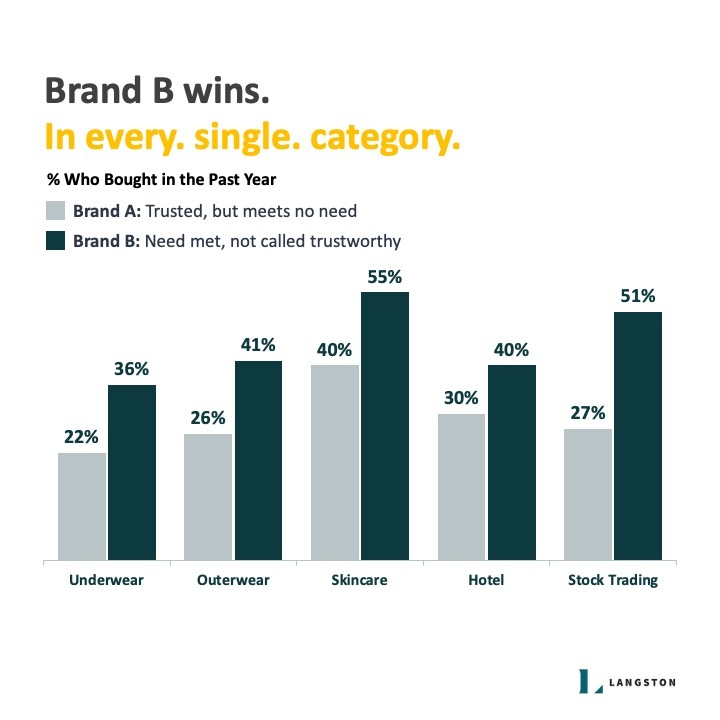
Across five consumer categories, brands perceived as meeting a consumer need were more likely to have been purchased in the past year than brands perceived as trustworthy but not meeting a need.
We also found that 32–41% of consumers didn’t identify a single brand they evaluated as trustworthy. Yet many of these consumers still associated brands with positive attributes like quality, value, and ease of use. They continued buying those brands, and some even recommended them to others.
The takeaway? Consumers don’t necessarily need to consider a brand trustworthy to recognize its value or make a purchase.
But that leads to another question. If trust isn’t always a prerequisite to purchase, what actually earns it?
The Connection Between Consumer Needs and Brand Trust
To understand what consumers associate with trust, we examined the attributes they assigned to individual brands.
The strongest associations were remarkably consistent. Safety, quality, reliability, comfort, and good value were closely linked to trust across categories. Meanwhile, attributes like trendiness, luxury, and playfulness showed much weaker relationships.
What stood out most, however, was the relationship between trust and the needs consumers believed brands could fulfill.
Across all five categories, only 10–20% of consumers considered a brand trustworthy when they didn’t see it meeting any of their needs. When a brand was perceived as fulfilling three or more needs, trust rose to approximately 52–58%.
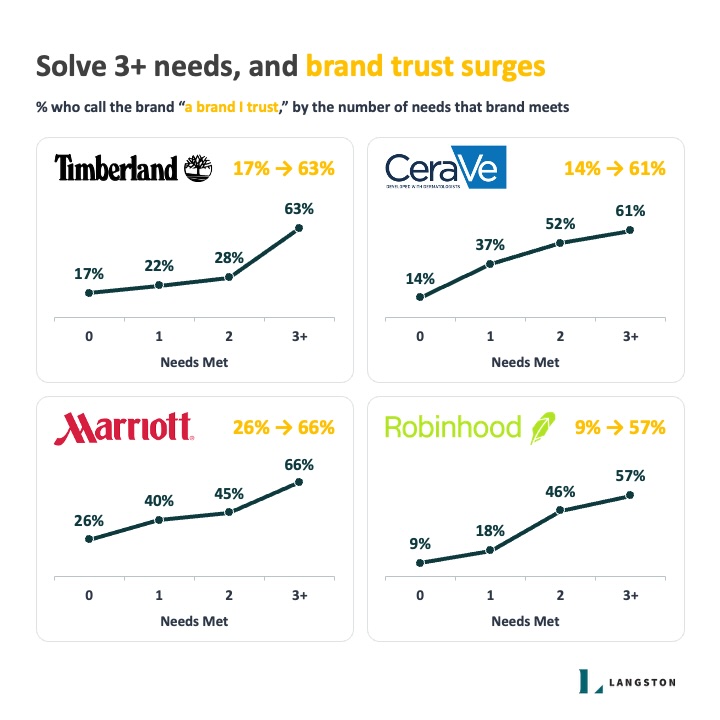
For four well-known brands, the percentage of consumers identifying the brand as trustworthy increased as the number of perceived needs met increased.
And these needs extend well beyond a product’s functional benefits.
A skincare consumer might want a product that protects their skin, but they may also want to feel more confident in their appearance. Someone choosing a financial platform might value ease of use while also seeking the security of knowing they’re protecting their family’s future.
Our research found that among consumers with both functional and emotional needs, approximately 30% trusted brands they saw meeting either type alone. That figure reached roughly 50% when consumers believed a brand fulfilled both.
Interestingly, this relationship existed even among consumers who had never purchased a brand. The perception that a brand could fulfill their needs was associated with greater trust before they ever experienced the product or service.
For marketers, this creates an opportunity to think more intentionally about the needs their brands fulfill and how effectively they’re communicating that value.
Where Trust Becomes Especially Valuable
While meeting consumer needs was strongly associated with purchasing behavior, our research revealed another important role for trust.
It was particularly powerful when it came to brand advocacy.
In skincare, for example, just 12% of consumers were brand promoters when they perceived a brand as neither trustworthy nor meeting their needs.
That increased to 30% when consumers trusted the brand but didn’t see it fulfilling a need, and 35% when the brand met their needs but wasn’t considered trustworthy.
When consumers perceived a brand as both trustworthy and meeting their needs, 55% were promoters.
We saw a similar pattern across all five categories, with promoter rates reaching approximately 50–56% when brands delivered on both dimensions.
This suggests a more nuanced role for trust throughout the consumer relationship. Consumers may purchase a brand because they believe it can fulfill a need, but the combination of perceived relevance and trust is associated with stronger advocacy.
Of course, these findings demonstrate relationships between consumer perceptions and reported behavior, rather than proving cause and effect. Still, they provide a valuable perspective on how trust and need fulfillment work together.
What Does This Mean for Marketers?
If consumer needs and trust are so closely connected, it’s worth reconsidering where brand-building efforts begin.
Rather than focusing exclusively on how to make a brand appear more trustworthy, marketers should be asking a few fundamental questions.
1. What are consumers actually trying to accomplish?
Purchase behavior tells us what consumers choose, but it doesn’t necessarily explain the motivations behind those decisions. Understanding the functional and emotional needs consumers are trying to fulfill can reveal opportunities for stronger positioning, messaging, and product innovation.
2. Which of those needs do consumers believe our brand fulfills?
There’s an important distinction between the value a brand intends to deliver and the value consumers actually perceive. Understanding where those perceptions align, and where gaps exist, can help identify opportunities to build relevance with current and prospective customers.
3. Are we giving consumers enough evidence to trust us?
Reliability, quality, and consistent performance were among the strongest associations with brand trust. But the proof consumers look for varies by category. For skincare, it might be visible results. For trading platforms, it might be security and dependability. Understanding what signals trust within your category can help focus marketing investments and strengthen the experiences behind the brand promise.
Ultimately, the research points to three principles for earning consumer trust:
- Understand the needs consumers are trying to fulfill.
- Deliver on those needs consistently.
- And make the value your brand provides unmistakably clear.
Because perhaps the biggest opportunity isn’t finding new ways to tell consumers your brand is trustworthy, but giving them more reasons to believe it.
How Well Are You Meeting Your Consumers’ Needs?
Understanding what consumers need is the first step. Knowing which needs are most important, how well they’re currently being met, and where opportunities exist is where things get interesting.
Our Consumer Needs Study quantifies 99 human needs to help brands uncover unmet needs, identify competitive white space, and discover new opportunities for growth.
Source: Langston Landscapes consumer research, 2025–2026. Findings reflect approximately 40,000 brand evaluations across five U.S. consumer categories.